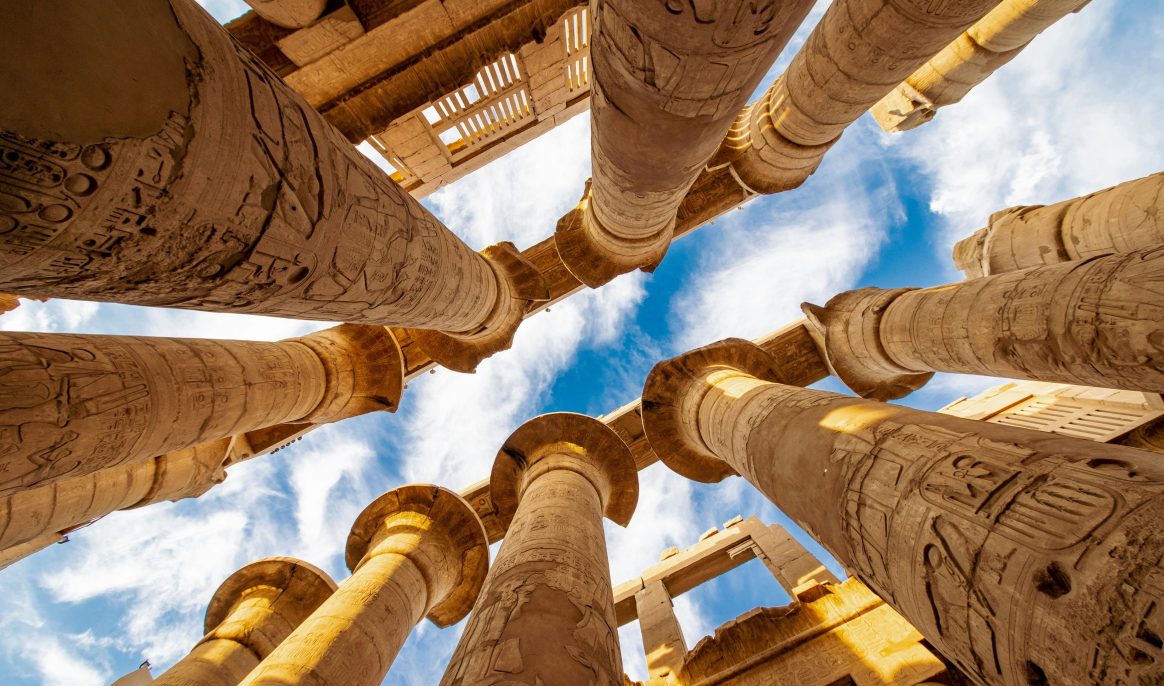
©CALIN STAN via Unsplash - image d'illustration de Luxor
-
Sep 18, 2026 10:00
In Luxor, a rock-cut chamber houses painted sarcophagi, mummies and sealed papyri from the Third Intermediate Period, virtually intact.
Inside the rock, on Luxor's western shore, the sarcophagi had been arranged with precision: a cramped space, exploited down to its last centimetre, painted wood, lids separated from vats, superimposed rows as in a repository where every gesture had been thought through. The Egyptian archaeological mission uncovered 22 polychrome wooden sarcophagi which still contained mummies, as well as a set of eight rare papyri, some still bearing their original clay seals. The discovery was made in the Gournah area, within the Asasif necropolis, one of the most important burial complexes in ancient Thebes, that is present-day Luxor.
The voices of Amun
On the sarcophagi, one title appears more often than the others: cantor or singer of Amun. Thus, instead of personal names, functions, roles and affiliations appear. It's a tiny, yet immense trace, as it shifts our gaze from the great royal figures to those who lived at the heart of the religious organization of the temples. Amun was one of the central deities of ancient Egypt, worshipped above all at Karnak, the great temple complex in Luxor. Singing to the god meant taking part in rites, feasts and ceremonies, moments when music, voice and gesture carried both sacred and social weight.
The chamber dates back to the Third Intermediate Period, between the 21st and 25th dynasties, roughly between 1070 and 664 BC. It's a less obvious phase to recount than the Egypt of the Pyramids or that of Tutankhamen: political power is fragmented, the Theban clergy retains a very strong role, and temples continue to be religious, economic and administrative centers. In this world, the singers of Amun held a recognized position. The fact that their titles recur so often on these sarcophagi opens a concrete window into the lives and deaths of women associated with the cult, respected figures whose material details have yet to be fully documented.
A room filled to the brim
The burial chamber was rectangular and dug directly into the bedrock. Archaeologists interpret it as a funerary repository, probably used to house sarcophagi displaced from earlier burials. The layout of the site strongly suggests this: ten horizontal rows, several levels and lids separated from the vats to optimize space. Here, mystery has less to do with gold than with ancient logistics, and responds to the need to protect, gather and preserve bodies and objects in a complex historical phase.
Alongside the sarcophagi, ceramic vases were also found. These are believed to contain materials used during mummification. An important detail. Oils, resins, natron, tissues, organic residues: each trace, if preserved, can add a piece to the puzzle of how bodies were treated and the passage to the afterlife prepared. In archaeology, a crust on a vase sometimes tells us more than a perfect statue.
These papyri still sealed
The eight papyri are perhaps the most delicate part of the discovery. They were housed in a large terracotta vase, and some still bear their clay seals. Before they can be studied, they will have to be restored, unfolded, translated and analyzed without being damaged. Inside could be religious texts, administrative documents, funerary formulas, temple and burial management registers. For the moment, it's their state of preservation that counts: the seal that has remained in place indicates exceptional preservation, a kind of closed envelope that has come down to us after almost three thousand years.
For the time being, the most urgent work concerns the sarcophagi. The wood is fragile, the fibers have deteriorated, the layers of painted plaster are lifting and the pigments are in danger of losing their adhesion. The restorers have intervened to carry out consolidation operations, mechanical cleaning and photographic and architectural documentation before transferring them to storage. Here, beauty comes second to stability. It's all about holding together what time has left standing.
Now we need to understand which tombs these sarcophagi came from. The mission is continuing its excavations precisely to reconstruct the path taken by the objects, bodies and people to whom they belonged. The question is where they were first buried, why they were moved and what religious network united them. Luxor continues to work in this direction: each new room seems closed, then opens up a corridor of questions larger than the room itself. And this time, inside the room, there were voices inscribed on the wood.
Source: Ministry of Tourism and Antiquities
Share: