-
May 22, 2026 16:13
A skilled juggler of words and a fan of black-and-white French cinema, Steven Patrick Morrissey was born in 1959 in Davyhulme, Lancashire, England.
He became famous as the singer and lyricist of his first band, The Smiths, between 1982 and 1987, although the role of the other three musicians in the quartet's alchemy is not to be overlooked. Guitarist Johnny Marr chiseled out a string of notes highlighting Morrissey's recurring themes: loneliness, of course, but also, sometimes as a result of each other, love and depression. From their first single, This Charming Man, on the Rough Trade label in 1983, he developed the graphic ideas for the covers, drawing his references from the classics of French cinema. He chose a photo of Jean Marais from Jean Cocteau's 1950 film Orphée. In an almost subliminal way, he signaled a homosexuality that he would eventually reveal publicly, although today he prefers to speak of "asexuality".
Later, he borrowed a photo of Alain Delon from the 1966 film L'insoumis for the cover of his album The Queen Is Dead. He also sometimes quotes the names of French actors in his lyrics, such as Claude Brasseur on At Last I Am Born or more recently, in 2017, Guillaume Canet on Home Is A Question Mark. As you can see, Morrissey is not only an avid cinephile and a talented poet, but also one hell of a nerd! During a concert at the Grand Rex in Paris in 2014, he even declared that the greatest achievement of his life was "to have been born on the same day as Charles Aznavour".
A proponent of a certain form of sarcasm and offbeat humor, when asked about his supposed homosexuality, he declared that he considers himself more of a "humasexual". He added that his "attraction to humans is limited to a very small number of them" (he said this to the American magazine Spin).
From This Charming Man to Hand In Glove, from Heaven Know I'm Miserable Now to Bigmouth Strikes Again, Morrissey has given us a few masterpieces of English rock. But he has also been at the heart of a handful of controversies. Is it really surprising for an artist who titled his first solo album Viva Hate? But he has always defended himself by claiming that he was misunderstood or that his words were hijacked by a sensationalist press. Indeed, while he has repeatedly declared that he "detests racism" (notably and vehemently in the columns of the English daily The Guardian), he nevertheless declares that "English identity is in peril because of immigration". It's true that little phrases like that, taken out of context, can have a devastating effect. Especially when it comes to an issue as complex as immigration.
A vegetarian since the age of 11, Morrissey also fights more consensual battles, notably in defense of animal welfare. Meat Is Murder, the title track of the Smiths' second album in 1985, was already a message towards this direction. Morrissey is a member of the PETA association and therefore logically bans meat consumption at his concerts. No frankfurters or hamburgers!
But rest assured, you don't have to delve into the twists and turns of Morrissey's tortured mind to appreciate his work.
In March 2026, with Make-Up Is A Lie, the English singer released his first album in six years and once again caused a stir. Still convinced that the industry is trying to muzzle his freedom of expression, he indulges - once again, we should say - in the defence of frivolous conspiracy theories. In Notre-Dame, for example, he claims without a shred of evidence that the burning of the Paris cathedral in 2019 was a criminal act. Nothing less than an anti-Christian attack. At times, one is tempted to remind him of certain premonitory Smiths songs such as Big Mouth Strikes Again (1986) or How Soon Is Now? (1984), in which he insists: "You shut your mouth/How can you say I go about things the wrong way?" A legitimate question, dear Morrissey!
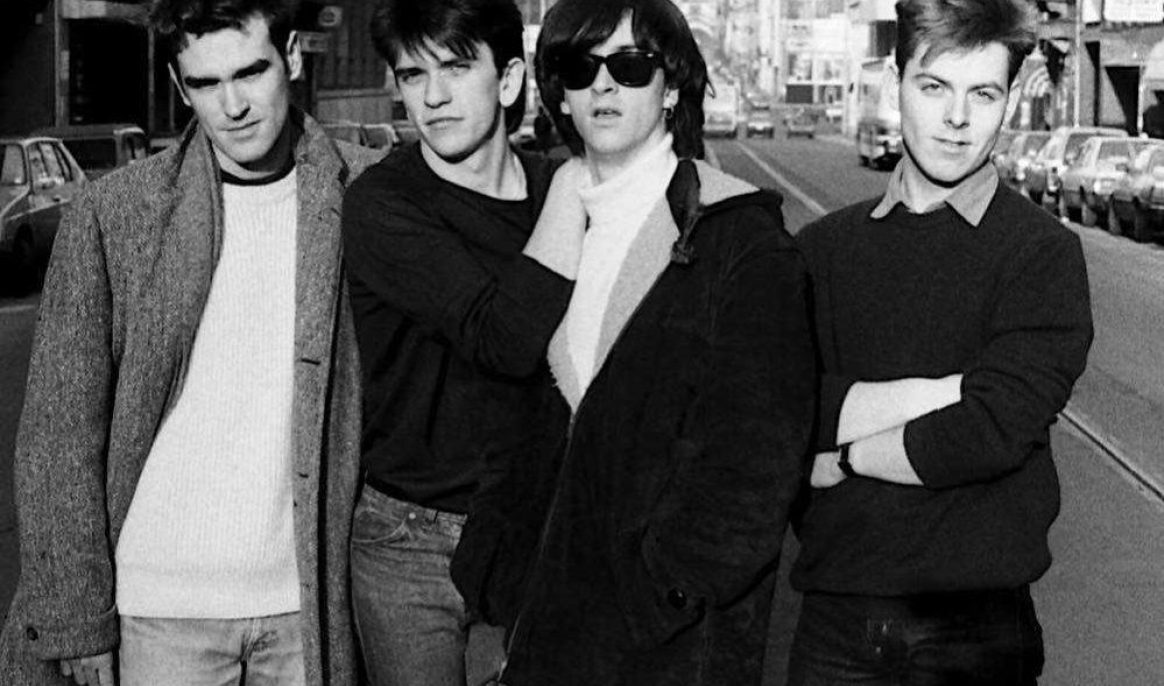
Photo: The Smiths and Morrissey (left) pose on Rue Royale in the center of Brussels (Belgium) in December 1983.
Share: