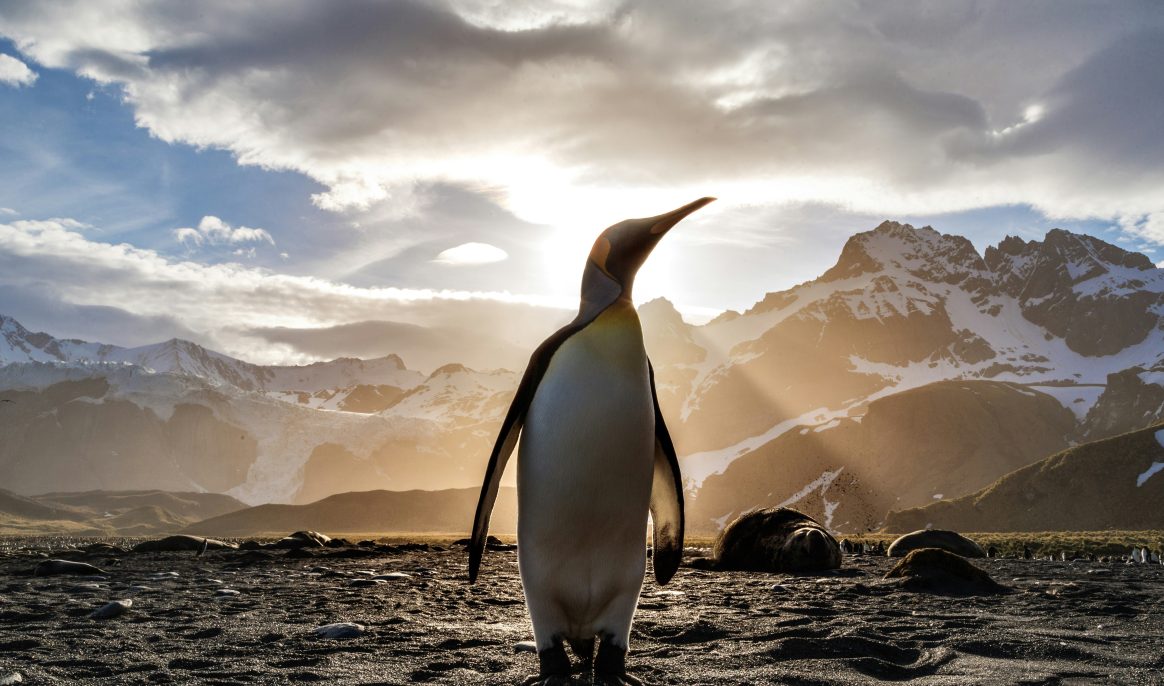
©Ian Parker via Unsplash - photo d'illustration d'un manchot
-
Sep 22, 2026 11:00
In Tierra del Fuego, a former kindergarten teacher has transformed a windswept farm into the continent's only colony of king penguins. Her story is one of patience, scientific research and cohabitation.
In Tierra del Fuego, there's a bay that explorers have long considered of little use: too shallow for ships, too difficult to access, too remote. Today, this stretch of the Chilean coast, lost at the ends of the earth, has become one of the most surprising conservation sites on the planet: the only continental colony of king penguins outside the sub-Antarctic islands. And that credit goes, at least in part, to a 72-year-old former kindergarten teacher.
Cecilia Durán Gafo's story, as told by The Guardian, seems straight out of a novel. When, in the early 1990s, she saw the first penguins appear on her property in Bahía Inútil, Durán had no idea that she would become the guardian of a colony destined to attract biologists and visitors from all over the world. King penguins, Aptenodytes patagonicus, live almost exclusively on islands in the Southern Ocean. Yet for centuries, they have frequented these windy shores of Chilean Patagonia, probably because the shallow waters offer them natural protection from large marine predators.
The beginnings of the colony
For a long time, however, the penguins were unable to establish themselves permanently. Too much human presence, too many disturbances. Cecilia Durán told The Guardian that some specimens had even been captured by people posing as scientific researchers. "They put the penguins in cages and took them to Japan," she told the British daily. After this, the animals disappeared for years.
When they returned in 2010, the scenario seemed to repeat itself: visitors were too intrusive, eggs were stolen, photos were taken just inches from the animals. "They'd put little hats and sunglasses on them to take selfies," recalls Durán. Before long, the colony had collapsed: out of around 90 individuals, only eight remained. It was then that Cecilia Durán took the decision to protect the penguins by cordoning off part of her property. She started alone, spending days on the beach to make sure no one disturbed the animals. "I'd come out here with a thermos and a sandwich," she says. "I'd stay all day, frozen to the bone."
In 2011, these lands officially became a private reserve dedicated to conservation for the next hundred years. Today, the protected area covers 30 hectares and is home to a team of biologists, veterinarians and ecotourism professionals. Tourism itself has found a new equilibrium here: visitors, up to 15,000 a year, can only observe the penguins from a distance, along signposted trails.
Night-time mink watching
The challenge wasn't just a human one. In Tierra del Fuego, mink and gray foxes, introduced by man in the last century, were attacking eggs and chicks. For years, the reserve team worked at night to keep them away from the colony. They bought leftover meat from local butchers and deposited it far from the protected area, thus getting the predators used to hunting elsewhere. Over time, the efforts paid off. Last year, 23 chicks survived: the highest number ever recorded in the colony.
An open-air laboratory
The reserve has also become a center for scientific research. Researchers working with the Antarctic Research Trust have observed that penguins arriving from colonies thousands of kilometers away are able to adapt quickly to the food available in the Chilean bay. An ability that could prove invaluable in a marine ecosystem increasingly disrupted by the climate crisis. Ultimately, the story of Bahía Inútil is memorable because it tells a story of a fragile cohabitation built on rules, patience and a constant presence, in a corner of the planet where the wind blows almost permanently and the penguins keep coming back.
Share: