©Aleksandra Sapozhnikova via Unsplash
-
Sep 04, 2026 10:00
In Glasgow, multispectral imaging brings 42 pages of Codex H back to life, revealing how the Letters (Epistles) of Saint Paul were read.
Sometimes, a book survives precisely because it has been mistreated. Cut up, moved, slipped into other volumes, reduced to mere workshop material... Good parchment, still solid, too precious to be thrown away. This is how Codex H has survived nearly fifteen centuries: losing pieces, changing function, leaving a kind of chemical shadow of the text it once carried on neighboring pages.
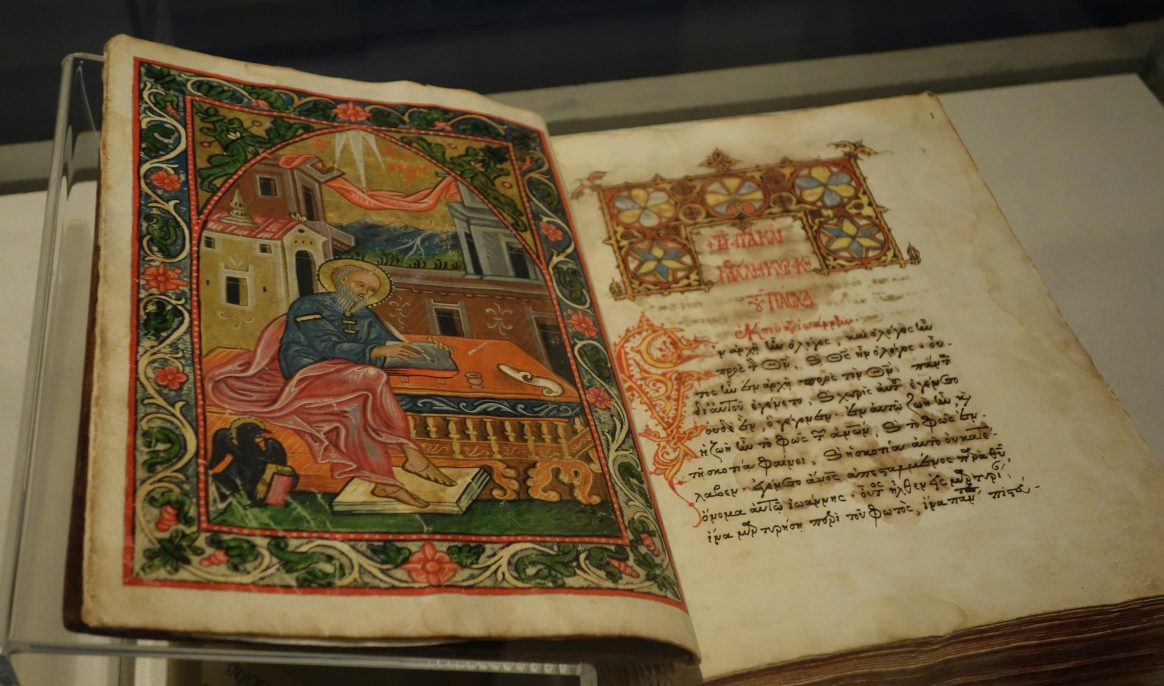
From these shadows, 42 lost pages of one of the most important ancient manuscripts linked to the New Testament have now been revealed. The work was carried out in Glasgow by Garrick Allen, Professor of Theology and Biblical Criticism, alongside an international group of researchers. Codex H is a 6th-century copy of the Letters of St. Paul, a very early witness to the way these texts were circulated, read, organized and understood.
Its history goes back to the Great Lavra Monastery on Mount Athos in Greece, one of the most important sites of Orthodox monasticism. Between the 10th and 13th centuries, the manuscript was dismembered. Some pages were reused as binding material, others as endpapers - pages placed at the beginning or end of a volume to protect the main text. A practical, medieval gesture, far less shocking than it seems to us today: parchment was expensive, books wore out, materials circulated.
From then on, Codex H began to disperse. The fragments known today ended up in institutions and libraries in Italy, Greece, Russia, Ukraine and France; other stages in its history also lead to Paris, Turin, Kyiv, Moscow, St. Petersburg and back to Mount Athos. An 18th-century French monk was among the first to recognize and catalog some of this material, giving a first order to an object that had lost its original body. For centuries, however, the manuscript remained a jigsaw puzzle with far too many pieces missing.
The turning point came with a physical detail. At a later stage in its life, the manuscript had been re-inked. This new ink, in contact with the adjacent pages, left light, almost invisible chemical traces. A kind of mirror image, an involuntary negative of the text. Researchers have dubbed them "ghost text": words that have disappeared from the original page and remained printed elsewhere, like an imprint left on glass for too long.
To read them, we had to resort to multispectral imaging, a technique that photographs the manuscript under different wavelengths of light, revealing signs that the human eye would be unable to perceive. In collaboration with the Early Manuscripts Electronic Library, the researchers analyzed the surviving pages and succeeded in extracting several levels of information from a single physical leaf. In practice, a preserved page could deliver the ghost of other lost pages. To confirm the age of the material, the team also worked with experts in Paris, using carbon-14 dating: the parchment does indeed date back to the 6th century.
The ghostly imprints of ink
The discovery must be seen for what it actually tells. The 42 pages found concern passages already known from the Pauline Epistles: no novel plot twists, then, with unknown passages from the New Testament. Its value lies elsewhere, and is far more interesting: in the way this text was organized, corrected and traversed by those who copied it and those who used it.
Indeed, Codex H preserves one of the earliest testimonies to the Eutalien apparatus, a system of text orientation composed of prologues, chapter lists, internal divisions, quotation markers and other tools designed to guide the reader. Before page numbering, before indexes as we understand them today, before the modern habit of finding a passage by means of quick, standardized coordinates, other "maps" had to be used. This is precisely what the manuscript shows: a Bible read with ancient editorial tools, built to accompany the eye and memory.
The new pages also allow us to observe the work of the scribes. Corrections, annotations, later interventions: minute yet decisive signs. The sacred text, in its material form, appears as a living object, manipulated, checked, put in order, read within very real communities. People who copied, compared and adjusted. People who needed to find their way among words, just as today's readers place a bookmark, underline a sentence or leave a note in the margin. Centuries pass, but the gesture of the hand seeking to find its bearings remains.
There's an almost touching paradox here too. The medieval practice of reuse, later judged severely by many 19th-century European collectors, helped save what seemed doomed to disappear. These pages, transformed into supports for other books, continued to exist. They lost their original function, but retained enough material to allow contemporary technology to make them speak again.
Garrick Allen has described the recovery of these new elements from the original Codex H as "monumental". For here, the past resurfaces without the need for staging: all that's needed is a 6th-century parchment, ink that has stained the wrong page and a machine capable of seeing where we see only silence.
Today, all that remains of Codex H are fragments, whereas the original must have consisted of hundreds of pages. A new printed edition is in preparation, and a digital version makes the recovered material available to researchers and the public.
Source: University of Glasgow
Share: