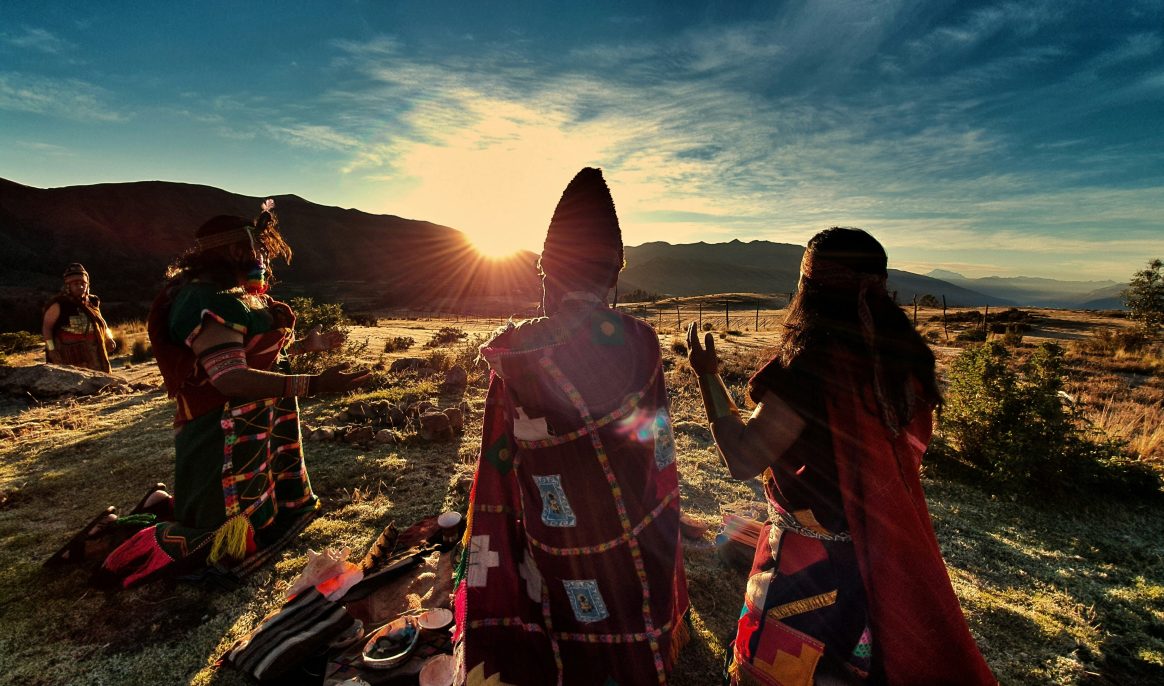
©YEYMY MAMANI via Unsplash - photo d'illustration d'un peuple autochtone
-
Jun 03, 2026 10:27
"Terricidio" is a book in which Moira Millán, guardian of the Mapuche territory in Argentina, denounces the systemic destruction of living things: not only of material ecosystems, but also of ancestral knowledge.
There are words that, when crossed, change the way we look at the world. "Terricide" ("terricidio" in Spanish) is one of them. It's not just a political or environmental neologism, but also a word born of the pain, resistance and memory of South America's indigenous peoples. A word that attempts to express a reality that terms such as "climate crisis" or "environmental catastrophe", on their own, can no longer contain.
But why? Because terricide also and above all encompasses the simultaneous annihilation of ecosystems, cultures, languages, communities, bodies and relationships. It's the genocide of peoples. The ecocide of the Earth. The epistemicide of ancestral knowledge. Feminicide as a tool of domination.
This concept was coined by Argentinian Mapuche activist and writer Moira Millán, who is now bringing this thinking to Europe with her essay "Terricidio. Sabiduría ancestral para un mundo alterNATIVO."
Giving violence a name
In the book, Moira Millán recounts how the concept of terricide was born out of listening to the stories of indigenous women: rape, disappearances, environmental devastation, land expropriation, persecution against native communities.
"At a certain point," she writes, "she realized that separate terms like ecocide, genocide or feminicide were no longer enough." Because everything was linked.
"Today, genocide no longer needs guns or bullets. It now comes through the criminalization of protest, when we oppose pollution, water scarcity, forest monocultures, agro-industry, large landholdings and noise pollution, among many other ways of weakening, sickening and killing us," she adds.
This is perhaps one of the most powerful aspects of the book: reminding us that the destruction of the planet never happens in isolation. When a forest is cut down, a culture is often wiped out too. When water is privatized, it's primarily the most vulnerable communities that are affected. When a territory is transformed into an extraction zone, biodiversity disappears, taking with it languages, spirituality and collective memories.
Terricide thus appears as a clear political and economic project.
Moira Millán's book
"Terricidio" is certainly an ecological essay, but it's also and above all a text that blends autobiography, spirituality, indigenous memory and a fierce critique of colonial capitalism. Millán writes as a Mapuche woman, as a "guardian of the Earth", as she defines herself.
"I was born with the 'newen' - the spirit - of weychafe, of one who defends life. I'm a guardian of the Mapu, the Earth, not a ruler. Weychafe comes from weychan, which means 'to fight'. Some people translate weychafe as warrior, but in reality this is not the case, because the Mapuche Nation was neither expansionist nor warlike, it defended itself. Weychan is the legitimate process of self-defense."
She doesn't speak of nature as an entity external to human beings, but as a living network of which we are part. That's why, in her pages, territory is never just territory: it's identity, belonging, memory and body. And that's also why, among the most intense passages, are those devoted to the uprooting of indigenous peoples, forced to abandon their lands to end up on the urban bangs, within a system that transforms everything into profit and consumption.
"Cities," says Millán, "become places of isolation, loss and disconnection from the Earth." And it's hard not to recognize, throughout these pages, a reality that concerns us all: the contemporary feeling of living ever more cut off from nature and from each other.
We are not all equally responsible
One of the book's most interesting points is its critique of the notion of the Anthropocene, that geological epoch dominated by human impact on the planet. For Millán, speaking of "humanity" generically risks erasing the historical responsibilities of colonialism and global capitalism.
"We have not all devastated the Earth in the same way," she writes. "There are peoples who, for centuries, have sought to live in balance with ecosystems, and it is often these same peoples who are hardest hit today by extractivism and economic violence."
"To speak of the Anthropocene is therefore to deny that there is a part of humanity that coexists in harmony - or at least tries to - with the Earth. I therefore felt it crucial to defend a new terminology; an approach that proposes a characterization of this reality by taking into account the point of view of telluric, indigenous peoples. Thus was born the concept of Terricidio."
It's a disturbing thought, but a necessary one. Especially today, when the climate crisis is increasingly presented as a simple technical emergency to be managed with new technologies and energy transitions, forgetting the profound inequalities that produced it.
Finally, the book's subtitle, "Sabiduría ancestral para un mundo alterNATIVO" (in English, "Ancestral wisdom for an alternative world"), might seem utopian. In fact, it's extremely concrete. Millán does not idealize indigenous peoples or propose an impossible return to the past. Rather, she invites us to restore another vision of our relationship with the Earth: not based on domination, but on reciprocity.
The text often refers to the Mapuche concept of "Buen Vivir", a life in harmony with the land, other living beings and the forces of nature.
"Buen Vivir' is the highest epistemological threshold for achieving physical, spiritual and mental health. Buen Vivir' is not possible without territory. That's why today it also represents the possibility of healing our bond with the Earth [...]"
Perhaps this is why "Terricidio" reaches us with such force: while the world continues to talk of infinite growth, Moira Millán forces us to ask ourselves a far more essential question: how can we continue to live without destroying what makes life itself possible?
Share: