©picture alliance / DUMONT Bildarchiv | Michael Riehle
-
Sep 07, 2026 10:00
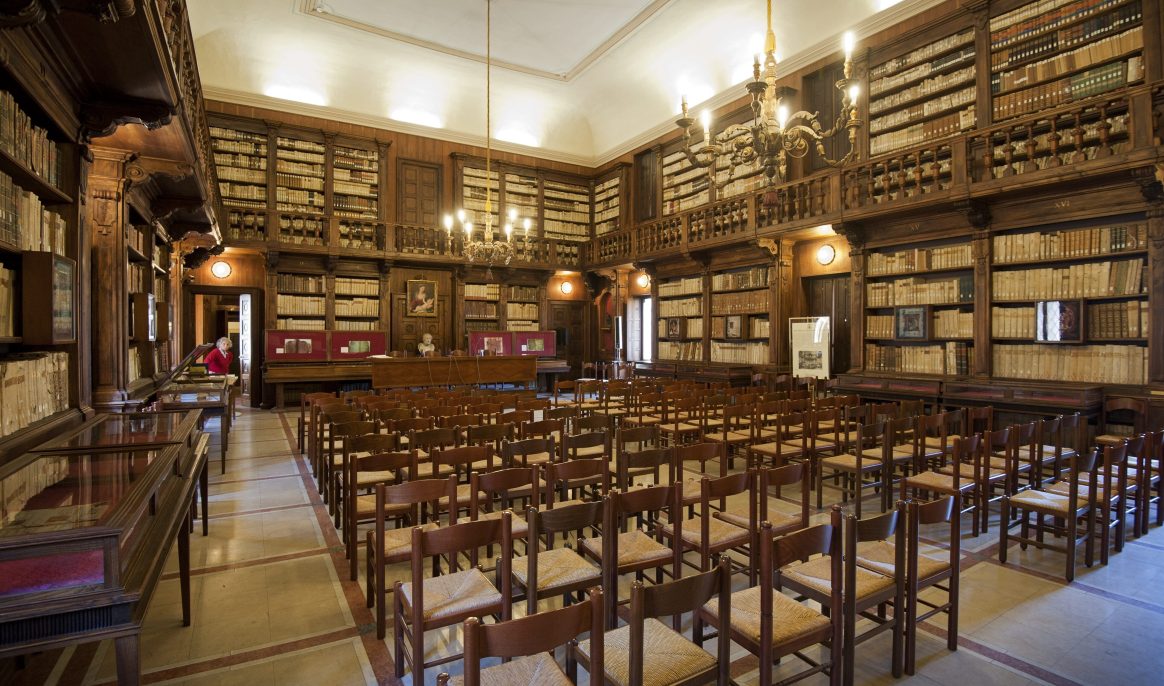
It is part of the Verona Cathedral architectural complex and is considered the world's oldest library still in use. This is not a record to be trumpeted, for the Chapter Library, or Capitolare, has existed since before Europe as we know it.
It was founded in the 5th century as an offshoot of the Scriptorium of the Schola majoris Ecclesiae, a book production workshop where the canons of the cathedral chapter (a community) wrote and composed works on parchment for the training of future priests. The first definite documentary evidence is the Codex of Ursicinus, the work of the priest Ursicinus who, after copying two hagiographic texts, affixed his signature to them, indicating the place and date: Verona, August calendas of the year of Agapet's consulate, i.e. August 1, 517 AD. J.-C. However, even older manuscripts, such as St. Augustine's De Civitate Dei and Gaius' Institutiones, could date the foundation of the library back to at least the previous century.
Earthquakes, plagues, Napoleon and allied bombs
Surviving sixteen centuries is also a matter of luck. Over the years, the Capitolare has taken on the appearance of an immortal building, to say the least: it withstood an earthquake in 1117, the plague, Napoleonic looting, the flood of 1882 and bombing raids. Each of these events has left its mark. The flooding of the Adige in 1882 damaged over 11,000 parchments, stained by mud, while the aerial bombardment of January 4, 1945 hit and destroyed the Great Hall. On this occasion, the librarian Giuseppe Turrini - the same man who had worked on the restoration of the damage caused by the flood - took over.had already sheltered the manuscripts and incunabula. Most of the less valuable volumes that remained under the rubble have now been recovered.
History also includes a legendary episode: in 1630, the plague struck Verona, killing two-thirds of the population, including the library's prefect, Agostino Rezzani, who had taken care to hide the oldest manuscripts. With him disappeared the exact location of this priceless heritage. It remained hidden for over a century, until Scipione Maffei, a leading figure in 18th-century Italy, made a fundamental contribution, with the help of Canon Carinelli, to finding these ancient manuscripts.
A heritage of over 1,200 manuscripts and three pieces unique in the world
The Capitolare conserves a collection of over 1,200 manuscripts, some of which are unique in the world, covering texts on theology, law, poetry, philosophy, astronomy, medicine, botany and history. In addition, there are some 100,000 printed volumes - incunabula, 16th- and 17th-century editions, as well as modern texts - and a collection of some 11,000 parchments, the oldest of which dates back to 710.
Three items deserve special mention. The first is the aforementioned Codex d'Ursicinus, material evidence of the scriptorium's activity in the 6th century. The second, also mentioned above, concerns the fifth-century Institutiones de Gaïus, the world's only text of classical Roman jurisprudence to have survived the Byzantine reworking of the Justinian reform. It is preserved as a palimpsest, i.e. a recycled manuscript. The third is the Indovinello veronese (or Verona Riddle), one of the earliest attestations of a transitional language between Latin and the vulgar tongue, scribbled in the margin of an 8th-century codex. This little enigma is, in fact, one of the very first documents written in what would later become Italian.
From Dante to Charlemagne: those who frequented the Capitolare
By the 14th century, the halls of the Capitolare had become a veritable center of cultural influence: Dante Alighieri stayed there in 1320, followed by Francesco Petrarca in 1345. Before them, Charlemagne and his son Pepin had already maintained relations with the Verona Chapter. Later, in 1816, the German epigraphist Barthold Georg Niebuhr was the first to identify, under a medieval Christian text, the text of the Institutioni di Verona.one of the most famous philological discoveries of the 19th century.
The library is still open to scholars, historians and researchers, who come here to analyze, transcribe and interpret the manuscripts, not forgetting the ongoing cataloguing, conservation and restoration work. One thousand five hundred years have passed, and the work is far from over.
Share: