© Etienne Tordoir
-
Jun 17, 2026 18:00
He was born in 1944 in Rio de Janeiro and has undoubtedly earned his place in the pantheon of Brazilian music.
A singer-songwriter known for songs such as “Joao e Maria” and “Calice,” Chico Buarque has greatly expanded his creative range, as he is also highly regarded as both a writer and a playwright in his home country. In 1967, under the military dictatorship, his play “Roda Viva” was banned by the generals, forcing its author into exile. Yet it was merely an allegorical and sarcastic critique of society, in which the authoritarian excesses of the military regime were only part of the story. Gilberto Gil, also a singer and fellow activist, faced similar hardships.
As early as the mid-1960s, with an album titled “Chico Buarque de Holanda” (his full surname), he established himself as a major figure in MPB (an acronym for “Música Popular Brasileira”), a rich musical genre blending traditional and modern influences.
A true master of both words and music, Chico Buarque stands out for the refined poetry of his lyrics as well as for his social conscience and political commitment. During the military dictatorship (1964–1985), he used allegories and metaphors—more than anyone else—to circumvent censorship. He thus became a symbol of intellectual resistance. Songs such as “Apesar de Você” and “Cálice” (co-written with Gilberto Gil) have become emblematic of this struggle.
His musical work is marked by great stylistic diversity, and incorporates samba, bossa nova, choro, jazz, and European influences. Also a successful writer, he is the author of works translated into several languages, notably “Budapest” and “The German Brother.” His very first novel, “Estorvo” (“Embrouille” in French), published in 1991, was adapted for the screen by Ruy Guerra in 2000 and screened at the Cannes Film Festival.
Like many other Brazilian artists (and perhaps even more so than others), Chico Buarque has had many of his songs translated into French. “O Que Sera?” was beautifully adapted by Claude Nougaro under the title “Tu verras” and then, a few years later, by Nicole Croisille. Others, such as Georges Moustaki, France Gall, Pierre Vassiliu, and Dalida, have also paid tribute to him. The prize for bad taste, however, goes to Sheila, who, during the yé-yé era, dared to transform the heart-wrenching “Funerale de um lavrador” (which can be translated as “Funeral of a Farmworker”) into an iconoclastic, bouncy tune titled “Oh mon dieu qu’elle est mignonne.” In the credits on the original album cover—further proof of the lack of respect for the author—Buarque’s “lavrador” thus becomes a “Labrador”!
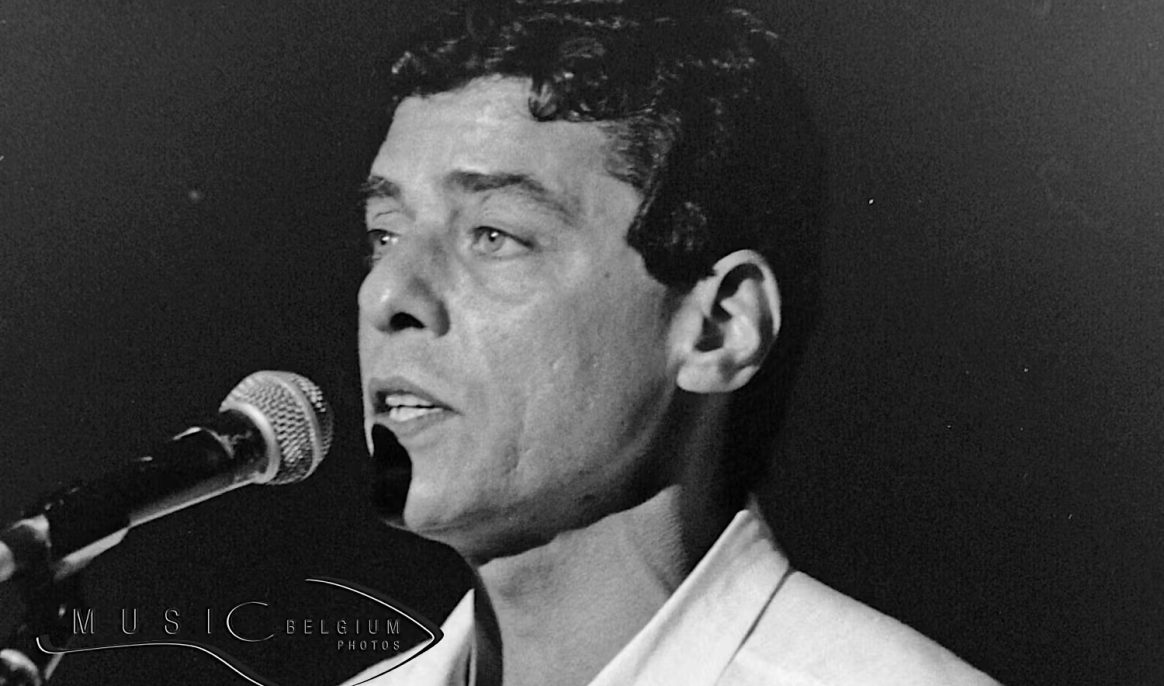
Photo: Chico Buarque on stage at Bozar in Brussels (Belgium) in April 1987
Share: