-
Apr 14, 2026 15:00
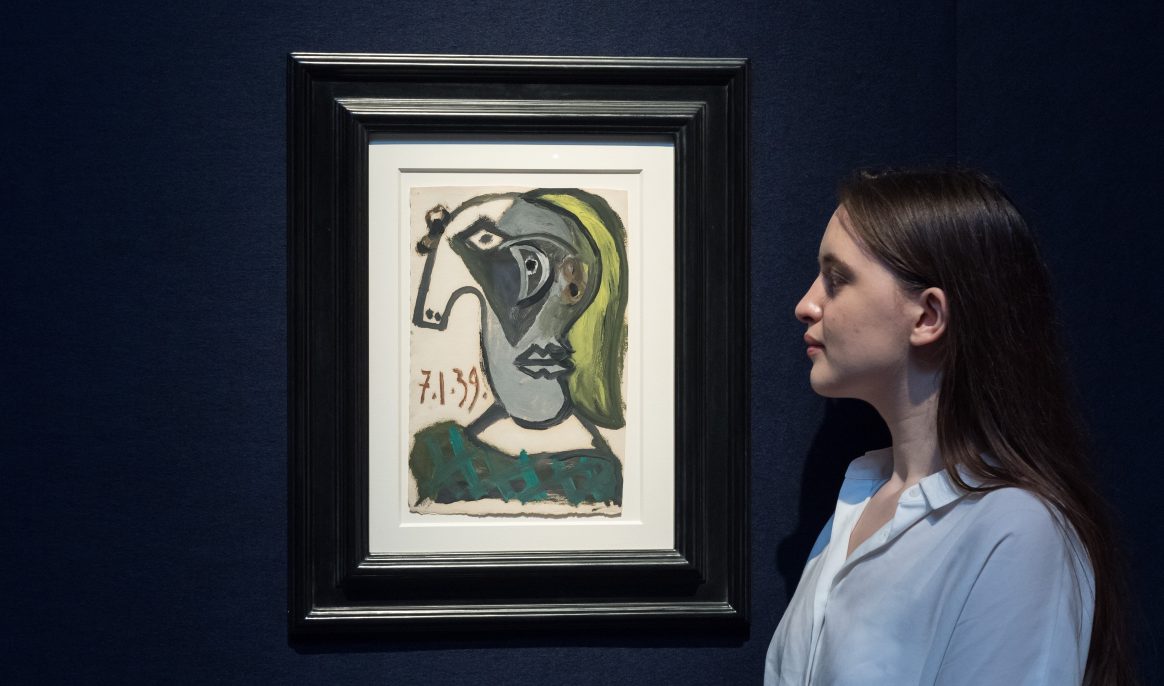
The international lottery "1 Picasso for 100 Euros" is back: this initiative allows you to buy a 100-euro ticket for a chance to win Tête de femme, a gouache painted by the artist in 1941.
The draw is scheduled for today, April 14, 2026, at 6 p.m. at Christie's in Paris, with the stated aim of raising funds for Alzheimer's research.
The work is a gouache on paper by Pablo Picasso, in a modest format - 38.9 by 25.4 centimetres - with an estimated value of one million euros. This third edition is presented as an international non-profit operation in aid of the Alzheimer's Research Foundation, with the support of the Succession Picasso, Picasso Administration, Opera Gallery and Christie's.
From an economic point of view, the mechanics of the operation are quite appealing: 120,000 tickets, 100 euros each, a single winner. If all the tickets are snapped up, the total raised could reach 12 million euros. According to the projections communicated on the eve of the draw, one million would go to Opera Gallery, owner of the work, and the rest to Alzheimer's research. In this context, one simple truth remains: almost everyone will lose the painting, but everyone will contribute to the fund-raising campaign.
At Christie's, the moment is approaching when a Picasso will become a number drawn at random.
The idea works precisely because it combines two very powerful imaginations. The first relates to very high-end art, which usually passes through the hands of collectors, galleries and auction houses, with amounts that exclude almost everyone. The second is a game, with a childlike, even absurd reflex: this time, it could be me. The organizers have long presented it in this way: as a symbolic shortcut to an unattainable art work and, at the same time, as a funding machine for research. Historical precedent also plays in its favor: the first edition dates back to 2013, the second to 2020, and the formula has already raised over 10 million euros in total.
The beneficiary foundation, created in 2004 and recognized as a public utility in France since 2016, presents itself as France's leading private funder of Alzheimer's research. The official documents put forward a few figures that give the measure of the project: over 29 million euros already invested, more than 175 researchers supported, over 40 teams involved in France and Europe. In the background, there's also IPCAR-2030, a program involving eight projects in France, Europe and North America, with budgets of at least one million euros each, spread over three years.
The painting at stake comes from a year that carries a lot of weight. In 1941, Paris was already under German occupation, with restrictions, fear, arrests and an oppressive atmosphere seeping into apartments, workshops and companies. In the texts it devotes to Picasso's works from this period, Christie's evokes a climate marked by scarcity, incessant rumors and repression. This is also why Tête de femme carries something that goes beyond a simple lottery: it's not just Picasso's name, it's also the date.
Previous editions tell the story of this project. In 2013, the draw raised around 4.8 million euros for an initiative linked to the city of Tyre, Lebanon. By 2020, over 5.1 million had been raised for water and sanitation programs supported by CARE in Cameroon, Madagascar and Morocco. In this second round, the work went to Claudia Borgogno, a chartered accountant from Ventimiglia, thanks to a ticket given to her by her son at Christmas. Once again, no matter where in the world the name drawn comes from, the final outcomes will be the same: a single winner and a room full of people watching a number turn into a painting.
To take part, you need to be at least 18 years old, and live in a country where online purchase of tickets for this type of tombola is permitted. Tickets are sold only on the official website and sent by e-mail. The draw will be broadcast live and will take place under the supervision of a court official.
Share: